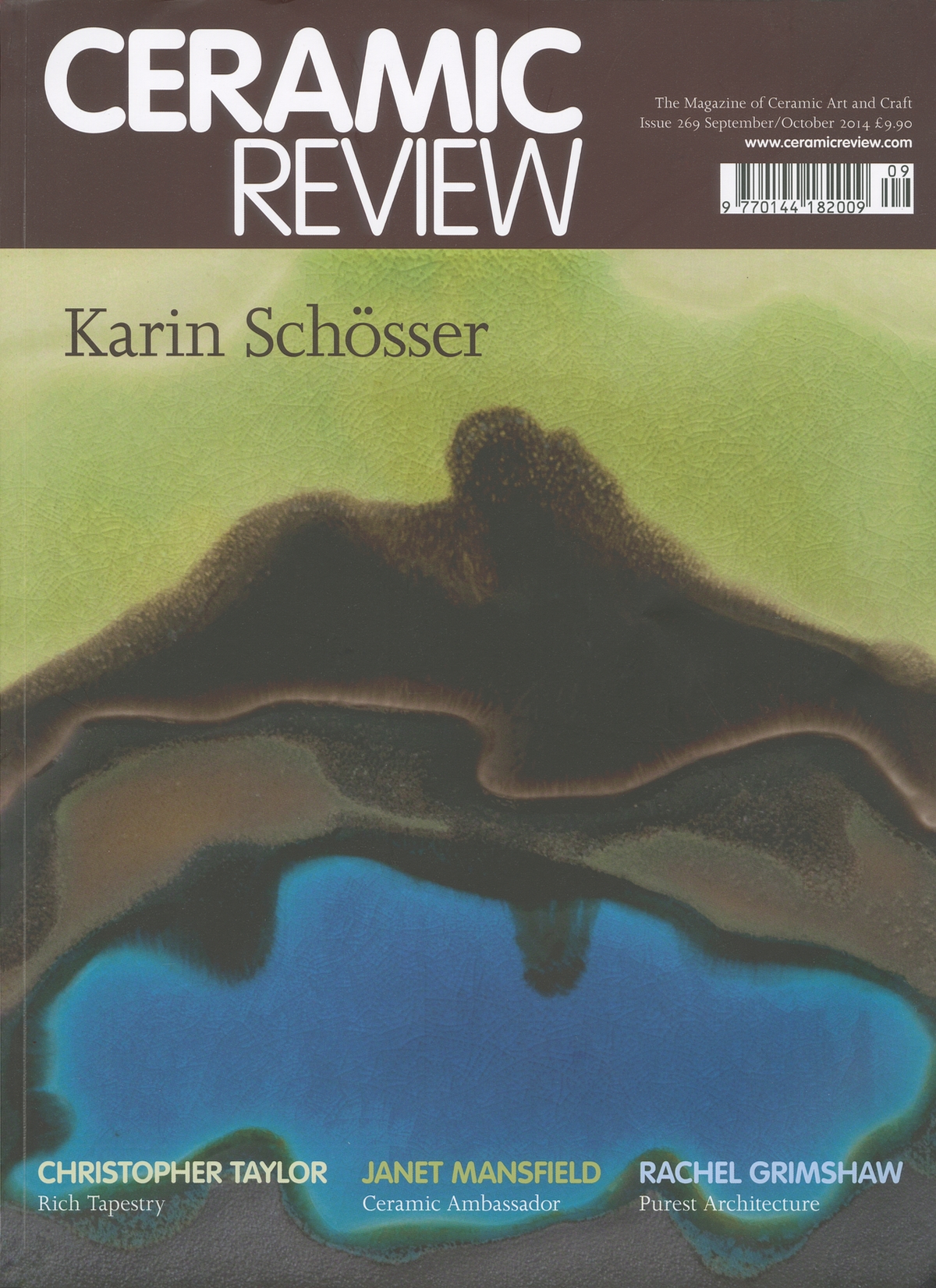
A Maker Greatly Missed
Following a tribute exhibition curated by Prue Venables, Inga Walton highlights the legacy of lanet Mansfield and a diverse selection of contemporary Australian ceramics.
Janet Winifred Mansfield OAM (1934-2013) had an indelible impact on the development, recognition, and trajectory of Australian ceramics at an international level. An artist of considerable renown whose work achieved widespread acclaim, she was also an educator, author, gallerist, lecturer, conference convener, and a vigorous creative facilitator. Mansfield devoted much of her time to advocating for her fellow artists and the status of their work in an increasingly fragmented, trend-driven, and capricious arts industry.
The two magazines she founded, Ceramics: Art and Perception (1990) and its companion Ceramics: Technical (1995), provided a vital forum for appraisal and professional discourse well beyond the parochial boundaries of Pottery In Australia, the national title she previously edited (1976-1989). Based in America from 2008, they continue under the editorship of Elaine Olafson Henry and serve as an ongoing testament to Mansfield’s dedication to the ceramic arts and her inclusive worldview.
Mansfield was a member of the International Academy of Ceramics (L’Académie Internationale de la Céramique) since 1981, and served as its president from 2006 to 2012. In 1987 she was recognised with the Medal of the Order of Australia (OAM) for her service to the arts, one of many honours she received in her career, including the Australia Council for the Arts Emeritus Award (1990), and an honorary Doctor of Letters from the University of Tasmania (2004).
The events that Mansfield organised were focused around her sheep farm ‘Morning View’ at Gulgong, about 300km northwest of Sydney in the Central Tablelands of the state of New South Wales. Their popularity testified to her passion for bringing artists together to foster dialogue, share techniques, and build relationships.
The Fire-Up Gulgong (1993) festival would be followed by an increasingly ambitious and well-attended triennial program with the ninth event, ClayPush (2013), serving as an affirmation of Mansfield’s life as delegates remembered their friend and mentor.
A Tribute A year after Mansfield’s death, curator and artist Prue Venables brought together works by twenty-five colleagues and admirers across a broad range of contemporary practice, from the veteran potter Owen Rye to the youngest participant, Amy Kennedy. An Important Exhibition of Australian Ceramics: A Tribute to Janet Mansfield provided an opportunity to celebrate this most beloved figure, and to honour her tremendous contribution to the field. ‘I was fortunate to have the opportunity to spend time with Janet on a number of occasions. She had an unbounded, passionate enthusiasm for clay in all its forms, accompanied by an insatiable thirst for learning. With great generosity and kindness, she taught, inspired, and supported ceramic artists worldwide and I was able to observe this first hand, says Venables.
The task of whittling down the works to be included was a taxing one. ‘This work all results from great courage, risk-taking, dedication, and imaginative exploration. I was looking for work that astounded me by its presence, its ability to move me, and its insistence that I stop and explore it. Rather than a theme based on a technique or some particular type or definition, I was looking for work that displayed a virtuosic level of technical innovation and skill as a backdrop for the making of expressive and intriguing forms – miraculous objects. Each piece selected was one that I would personally like to live with, to explore and get to know, a that, through its presence, would alter my life.’
Butterfly motifs – Vipoo Srivilasa’s Butterfly (2011) was informe by the Thai proverb ‘To cover one whole dead elephant with a lo leaf, and makes reference to the exposure of corruption in Thai politics. There has been ongoing political instability since the September 2006 coup that saw the ousting of Prime Minister Thaksin Shinawatra. The recent military coup in May saw his sister Yingluck Shinawatra meet the same fate. Thailand’s economy and international reputation have suffered greatly through this protracted unrest.
‘Janet has been a great supporter of me and my work, and inspired me to do what I do now, connect people together. She was a great teacher – by not teaching, but doing. Janet, you are my idol. You are always on my mind, forever in my heart. I will miss you, says an emotional Srivilasa.
Another piece smothered in butterflies, Jesus II (2010), is from Lynda Draper’s series Home Altar (2007-11), which saw the artist reconfigure a group of souvenirs collected from her childhood home prior to its sale and demolition, evoking feelings of both nostalgia and unease. Draper explains its origins: ‘On reflection, this work arose from an unconscious reaction to the insecurity of the present, to a sense of alienation, to the passing of time and to an uncanny sense of death.’
Playing with the past – David Ray plays with influences from the eighteenth-century European porcelain tradition, where exacting industrial forms were largely devoid of any evidence of the maker’s touch, and whose designers often worked at a remove from direct hand-crafting. Ray’s forms often refer to issues of consumerism, the more contentious aspects of Australian national identity, and contrasting perceptions of beauty and ugliness. The absurdist and lopsided Tower (2012) looks like it might overbalance; Cracked (2012), reminiscent of an ornate clock with its face missing, would certainly not pass quality control at one of the large ceramic manufacturing houses.
Function: Intended, implied, imagined – Teaware is a staple of the ceramic canon, and few have a better ‘grasp’ of the harmonious interplay between spout, handle, lid, and shoulder than Bruce Nuke.
The intricacies of nature, and Nuke’s interest in botany and zoology, are evident in his confident brushwork adorning vessels like Brown Leaf Tea and Green Coffee (both 2014). ‘My work invariably has a sense of “plantness”. It is my identity, my observation, my memory, a constant source of pleasure, reflection and loss,’ he observes.
‘Function is intended, implied, or imagined. Decoration is the visual embrace; a metaphor for belonging and celebration, but also a lament for our exploitation and disconnection to nature’s ravaged and vanishing world.’
A sense of place – Many artists find their inspiration in the extraordinary diversity of the Australian landscape. The evocative sculptures of Jane Sawyer convey her impressions of the Murray River and its environs with River Reflections: Black Water #1, Rec Gum #1, and Flow #1 (all 2013). Sawyer alludes to the impact of uman behaviour on the ecosystem, the changes wrought by annual flooding, but also the dynamic relationship between the wet clay and the maker’s hands in the forming of these works. The vivid colours used by Pippin Drysdale echo the baked red earth, the majesty of soaring geological formations, and infinite horizons of the desert regions. Titania Henderson’s bone china Remembering, If (2012-13) has an inscrutable ghostly quality: six white elongated cone structures suggest curls of bark, or perhaps leaf detritus.
A formidable ambassador – Mansfield’s contribution to the field will continue to resonate, such was the influence of one of the ceramic community’s most formidable ambassadors. As the then Australian Prime Minister Julia Gillard noted, ‘Mansfield’s long and distinguished life saw her rise to the peak of her chosen field… and represent our country with passion and flair… a woman of fine intelligence, creative depth, and generosity of spirit who is justly regarded as an international treasure… She leaves a powerful legacy not only in her art and her writings but in the love and respect you will continue to feel for her.
 TITANIA HENDERSON